
Study the Impact of Active Cooling Systems on Solar Cell Efficiency
DOI:
https://doi.org/10.51173/jt.v7i2.2589Keywords:
Renewable Energy, Photovoltaic Cells, Temperature, Cooling System, EfficiencyAbstract
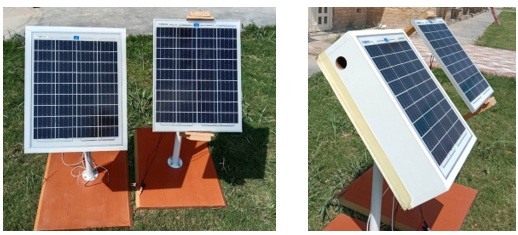
The performance development of photovoltaic systems has become crucial with the increasing demand for renewable energy sources. Cooling systems play a crucial role in maintaining solar cell temperatures within optimal ranges, thereby improving their overall efficiency. This study presents an experimental investigation into the effectiveness of fan-based cooling systems aimed at enhancing the efficiency of solar cells. In this experiment, a cooling system was tested under limited environmental conditions to assess its impact on solar cell performance. It was concluded from the results that reducing the temperature using the air-cooling system did not significantly impact the efficiency of the solar cell when the temperature was below 50 degrees Celsius; however, the proposed cooling system was effective in reducing the temperature of the solar cell by 18 °C relative to the reference solar cell.
Downloads
References
J. Praveen, and V. VijayaRamaraju, “Materials for optimizing efficiencies of solar photovoltaic panels”, Materials Today: Proceedings, Vol. 4, No. 4, pp. 5233–5238, 2017, https://doi.org/10.1016/j.matpr.2017.05.032.
Q.A.H. Al-Naser, N.M. Al-Barghooth, and N.A. Al-Ali, “The effect of temperature variations on solar cell efficiency”, International Journal of Engineering, Business and Enterprise Applications (IJEBEA), Vol. 4, No. 2013, pp. 108-112, 2013.
D. Swapnil, J. N. Sarvaiya, and B. Seshadr, “Temperature Dependent Photovoltaic (PV) Efficiency and Its Effect on PV Production in the World – A Review”, Energy Procedia, Vol. 33, No. 2013, pp. 311-321, 2013, https://doi.org/10.1016/j.egypro.2013.05.072.
Pveducation, [Online]. Available: https://www.pveducation.org/pvcdrom/solar-cell-operation/effect-of-temperature.
V.B. Ignacio, D. Lopez-Pascual, P. Diaz-Villar, Ricardo Mallol-Poyato, Alberto Barragan, Manuel Ocaña, Guido Granello, and Efren Diez-Jimenez, “Efficiency Improvement of Photovoltaic Solar Modules by Cooling Using an Underground Heat Exchanger”, J. Sol. Energy Eng., Vol. 144, No. 6, pp. 061015-061025, 2022, https://doi.org/10.1115/1.4055299.
Libra, M., Petrik, T., Poulek, V., Tyukhov, I. I., and Kourim, P., “Changes in the Efficiency of Photovoltaic Energy Conversion in Temperature Range With Extreme Limits”, IEEE J. Photovolt., Vol.11, No. 6, pp. 1479–1484, 2021, https://doi.org/10.1109/JPHOTOV.2021.3108484.
Mustapha Dida, Slimane Boughali, Djamel Bechki, Hamza Bouguettaia, “Experimental investigation of a passive cooling system for photovoltaic modules efficiency improvement in hot and arid regions”, Energy Conversion and Management, Vol. 243, No. 1, pp. 114328, 2021, https://doi.org/10.1016/j.enconman.2021.114328.
EQO, Impact of Temperature on solar panels efficiency, https://www.mahindrateqo.com/blog/impact-of-temperature-on-solar-panels-efficiency/.
K. Jäger, O. Isabella, A.H.M. Smets, R.A. Van Swaaij, M. Zeman, Solar energy; Fundamentals, Technology, and Systems, Delft University of Technology, Netherlands, 2014.
M. J. Kadhim, M. A. Glob, “The Effect of Double Spectrum Colors Factor on Solar Cells Performance in Inorganic Solar Cells”, Journal of Chemical Reviews, Vol. 5, No. 4, pp. 353–379, 2023, https://doi.org/10.22034/JCR.2023.390191.1217.
A.J. Mahmood, “Experimental study for improving unglazed solar system”, Cogent Engineering, Vol. 19615641, No. 8, pp. 1–17, 2021, https://doi.org/10.1080/23311916.2021.1961564.
E. Koutroulis, K. Kalaitzakis and N. C. Voulgaris, "Development of a microcontroller-based, photovoltaic maximum power point tracking control System", IEEE Trans. Power Electron, Vol. 16, No. 1, pp. 46-54, 2001, https://doi.org/10.1109/63.903988.
A. Luque and S. Hegedus, Handbook of Photovoltaic Science and Engineering, John Wiley and Sons Ltd, Chichester, England, 2003.
E. Lorenzo, Solar Electricity- Engineering of Photovoltaic Systems, PROGENSA, S.A., Sevilla, Spain, 1994.
S. Sze, Physics of semiconductor Devices, John Wiley &Sons, New York, USA, 1981.
M.K. El-Adaw, S.A. Shalaby, S.E.S. Abd El-Ghany, and M.A. Attallah, “Effect of solar cell temperature on its photovoltaic conversion efficiency”, International Journal of Scientific & Engineering Research, Vol. 6, No. 3, 1356-1384, 2015.
Muzzillo, Christopher P., Jonathan D. Poplawsky, Ho Ming Tong, Wei Guo, and Tim Anderson. "Cover Image, Volume 26, Issue 10." Progress in Photovoltaics: Research and Applications, 26, No. 10, 3-12, 2018, https://doi.org/10.1002/pip.3074.
Agrafiotis, Christos C., Ilias Mavroidis, Athanasios G. Konstandopoulos, Bernard Hoffschmidt, Per Stobbe, Manuel Romero, and Valerio Fernandez-Quero. "Evaluation of porous silicon carbide monolithic honeycombs as volumetric receivers/collectors of concentrated solar radiation." Solar energy materials and solar cells, Vol. 91, no. 6, 474-488, 2007, https://doi.org/10.1016/j.solmat.2006.10.021.
Camblong, Haritza, Joseph Sarr, A. T. Niang, Octavian Curea, J. A. Alzola, E. H. Sylla, and M. Santos. "Micro-grids project, Part 1: Analysis of rural electrification with high content of renewable energy sources in Senegal." Renewable energy, Vol. 34, no. 10, 2141-2150, 2009, https://doi.org/10.1016/j.renene.2009.01.015.
Downloads
Published
How to Cite
Issue
Section
License
Copyright (c) 2025 Afaq Jasim Mahmood, Muhammed J. Kadhim, Raheleh Nowzari, Faeza Saleh Dlhin

This work is licensed under a Creative Commons Attribution 4.0 International License.