
Experimental Study on Dehumidification by Silica Gel Blue Using Dehumidification System and Air-Conditioning
DOI:
https://doi.org/10.51173/jt.v7i4.2673Keywords:
Renewable Energy, Adsorption Materials, Air Conditioning, HVAC Processes, Solar EnergyAbstract
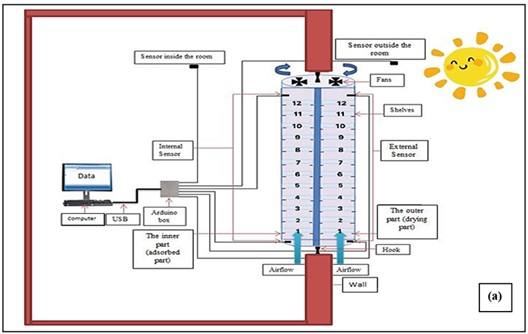
The growing issue of energy shortages has been exacerbated by the increasing demand for air conditioning in tropical regions. This has highlighted the need for supplementary methods to reduce the load on air conditioning systems and thereby lower energy consumption. The objective of this study is to evaluate the effectiveness of silica gel-Blue as a dehumidifying agent for removing moisture generated from sources such as human respiration, perspiration, and household activities like ironing. To address this problem, a dehumidification system was designed consisting of several shelves loaded with silica gel-blue to help absorb moisture. Experimental tests were conducted using a dehumidification system in conjunction with an air conditioning system, measuring its moisture absorption capacity and its impact on relative humidity and energy consumption. The results showed that relative humidity levels decreased to 33%, 29%, and 25% in June, July, and August, respectively, when using the combined system. The moisture absorption rates of silica gel-Blue were recorded as 83.39 g/h in June, 70.82 g/h in July, and 65 g/h in August. It was also found that approximately 750 g of silica gel-blue was required to remove the moisture produced by one person. Furthermore, the electrical energy consumption was reduced to 3.5 kWh with the dehumidification system, compared to 5.1 kWh without it. These findings confirm the efficiency of silica gel-Blue in humidity control and demonstrate its potential for reducing energy usage when integrated with air conditioning.
Downloads
References
Kusch-Brandt, “Urban Renewable Energy on the Upswing: A Spotlight on Renewable Energy in Cities in REN21’s ‘Renewables 2019 Global Status Report,’” Resources, vol. 8, no. 3, p. 139, 2019, DOI: 10.3390/resources8030139.
“Dynamic modeling and analysis of a 20-cell PEM fuel cell stack considering temperature and two‑phase effects,” Journal of Power Sources, vol. 179, no. 2, pp. 660–672, Jan. 2008, DOI: 10.1016/j.jpowsour.2008.01.029
L. Tarish, A. H. N. Khalifa, and A. J. Hamad, “Methods of Improving the Performance of Adsorption Thermophysical Battery Based on the Operating Conditions and Structure: A Review,” IOP Conf. Ser.: Mater. Sci. Eng., vol. 928, no. 2, 2020, DOI: 10.1088/1757-899X/928/2/022040.
L. Xiaohua, Y. Jiang, and T. Zhang, Temperature and Humidity Independent Control (THIC) of Air‑Conditioning System, Springer, Berlin Heidelberg, 2013, DOI: 10.1007/978-3-642-42222-5.
Y. D. Tu, R. Z. Wang, T. S. Ge, and X. Zheng, “Comfortable, High-Efficiency Heat Pump with Desiccant-Coated, Water-Sorbing Heat Exchangers,” Sci. Rep., vol. 7, 2017, DOI: 10.1038/srep40437.
S. Rathore et al., “A Review on Neuroimaging-Based Classification Studies and Associated Feature Extraction Methods for Alzheimer’s Disease and Its Prodromal Stages,” Neuroimage, vol. 155, pp. 530–548, 2017, DOI: 10.1016/j.neuroimage.2017.03.057.
U. Chaudhari and V. Muchhara, “Study of Swelling and Shrinkage Characteristics of Expansive Soil Using Silica Gel as an Admixture,” Lect. Notes Civ. Eng., vol. 136, pp. 685–691, 2021 DOI: 10.1007/978-981-33-6444-8_61.
E. P. Ng and S. Mintova, “Nanoporous Materials with Enhanced Hydrophilicity and High Water Sorption Capacity,” Microporous Mesoporous Mater., vol. 114, no. 1–3, pp. 1–26, 2008, DOI: 10.1016/j.micromeso.2007.12.022.
E. Kamel, S. Habibi, and A. M. Memari, “State of the Practice Review of Moisture Management in Residential Buildings through Sensors,” Structures, vol. 59, 2024, Art. no. 105698, DOI: 10.1016/j.istruc.2023.105698.
S. Alahmer, S. Alsaqoor, and G. Borowski, “Effect of parameters on moisture removal capacity in the desiccant cooling systems,” Case Studies in Thermal Engineering, vol. 13, p. 100364, 2019, DOI : 10.1016/j.csite.2018.11.015.
M. Posani et al., “Low-Carbon Indoor Humidity Regulation via 3D-Printed Superhygroscopic Building Components,” Nat. Commun., vol. 16, no. 425, 2025, DOI: 10.1038/s41467-024-54944-1.
I. Lopez-Carreon et al., “Moisture Ingress in Building Envelope Materials: (II) Transport Mechanisms and Practical Mitigation Approaches,” Buildings, vol. 15, no. 5, 2025, p. 762, DOI: 10.3390/buildings15050762.
Y. Bi, W. Yang, and X. Zhao, “Numerical Investigation of a Solar/Waste Energy Driven Sorption/Desorption Cycle Employing a Novel Adsorbent Bed,” Energy, vol. 149, pp. 84–97, 2018, DOI: 10.1016/j.energy.2018.02.021.
S. Singh, S. Kumar, and R. Dev, “Studies on Cocopeat, Sawdust and Dried Cow Dung as Desiccant for Evaporative Cooling System,” Renew. Energy, vol. 142, pp. 295–303, 2019, DOI: 10.1016/j.renene.2019.04.122.
M. H. Yari et al., “Moisture Ingress in Building Envelope Materials: (I) Scientometric Analysis and Experimental Fundamentals,” Buildings, vol. 15, 2025, p. 798, DOI: 10.3390/buildings15050798.
H. N. Al-Deen and A. Al-Samari, “Experimental Assessment of Combining Geothermal with Conventional Air Conditioner Regarding Energy Consumption in Summer and Winter,” Diyala J. Eng. Sci., vol. 14, no. 3, pp. 94–107, 2021, DOI: 10.24237/djes.2021.14308.
C. H. Chen et al., “Silica Gel/Polymer Composite Desiccant Wheel Combined with Heat Pump for Air-Conditioning Systems,” Energy, vol. 94, pp. 87–99, 2016, DOI: 10.1016/j.energy.2015.10.139.
K. C. Ng et al., “Experimental Investigation of the Silica Gel-Water Adsorption Isotherm Characteristics,” Appl. Therm. Eng., vol. 21, no. 16, pp. 1631–1642, 2001, DOI: 10.1016/S1359-4311(01)00039-4.
W. F. Stoecker and J. W. Jones, Refrigeration and Air Conditioning, 2nd ed., McGraw Hill, Singapore, 1979, ISBN‑13: 978‑0070616196
S. K. Wang, Air Conditioning Systems: System Classification, Selection, and Individual Systems, 2001. ISBN 0070681678.
M. S. Owen, 2009 ASHRAE Handbook: Fundamentals, vol. 30329, 2009.
H.-M. Henning, “Solar Assisted Air Conditioning of Buildings—An Overview,” Appl. Therm. Eng., vol. 27, no. 10, pp. 1734–1749, 2007. DOI: 10.1016/j.applthermaleng.2006.07.021
Hybrid Liquid Desiccant/Vapour Compression Air‑Conditioning Systems: A Critical Review,”in Proc. ASME ESDA, 2008, pp. 45–57, DOI: 10.1115/ESDA2008-59344.
Jones, W. P., Air Conditioning Engineering, 5th ed., Routledge, London, 2001 (ebook 2007), DOI: 10.4324/9780080498942.
J. Yang and Y. Kim, “Experimental Analysis of Energy Savings in a Combined Rotary Desiccant Dehumidifier with a Purge Section,” Sustainability, vol. 17, no. 9, Art. no. 4126, May 2025, DOI: 10.3390/su17094126.
Downloads
Published
How to Cite
Issue
Section
License
Copyright (c) 2025 Amna Samir Ibrahim, Ahmed Al-Samari, Mays Abdulrazzaq Nayyef, Mays Alaa Ismael

This work is licensed under a Creative Commons Attribution 4.0 International License.