
DFT+U Study of Fe-Doping Enhanced Random Lasing in ZnO Nanorods: Quantum Confinement and Vacancy Effects
DOI:
https://doi.org/10.51173/jt.v8i2.2970Keywords:
Random Lasing, ZnO Nanorods, Fe Doping, Oxygen Vacancies, DFT+U, Quantum Confinement, Photonic MaterialsAbstract
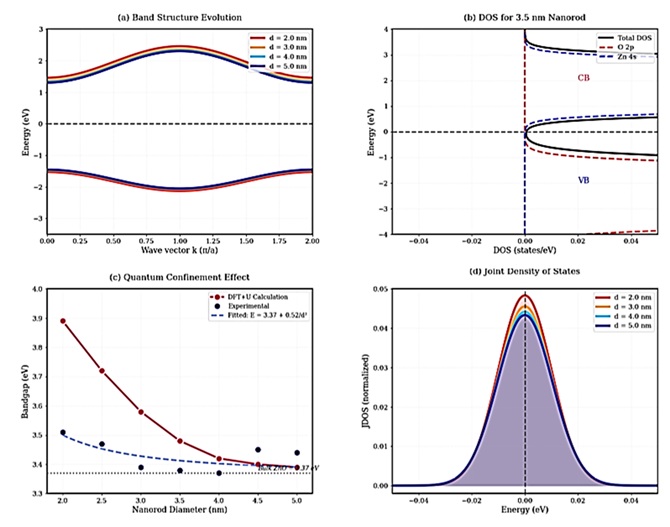
This paper aims to evaluate how Fe-doped ZnO nanorods with controlled oxygen-vacancy levels can improve random lasing performance for photonic applications. An investigation of the electronic structure, defect dynamics, and optical properties of these nanostructures is accomplished through density functional theory (DFT+U) calculations. Specifically, it has been reported that the incorporation of about 3 at.% Fe can introduce intermediate 3d energy levels in the ZnO bandgap, suggesting the possibility of carrier population inversion and an estimated reduction of the lasing threshold by approximately 30–40% for Fe-doped ZnO nanorods compared to undoped nanorods, under idealized theoretical assumptions. It is also determined that oxygen vacancies act as scattering centers, altering the local electromagnetic environment around the ZnO nanorods and thereby optimizing the gain. Additionally, quantum confinement is predicted to dominate the emission from ZnO nanorods with diameters below 4 nm, thereby shifting the emission spectrum to higher energy (i.e., a blue shift) and increasing the nanorods' oscillator strength. Therefore, it is fair to anticipate that optimum random lasing would occur in ZnO nanorods having diameters of 3-4 nm, doped at 2-3 at.% Fe, and synthesized in oxygen-deficient environments. Although all computations in this study have made assumptions about the configuration of defect sites and the degree of oxidation of ZnO nanorod surfaces, these theoretical results may help to develop the next-generation materials for a range of applications, including biosensing, imaging, and photonics.
Downloads
References
Ü. Özgür et al., "A comprehensive review of ZnO materials and devices," J. Appl. Phys., vol. 98, no. 4, p. 041301, 2005. doi: 10.1063/1.1992666.
M. H. Huang et al., "Room-temperature ultraviolet nanowire nanolasers," Science, vol. 292, no. 5523, pp. 1897–1899, 2001. doi: 10.1126/science. 1060394.
H. Cao et al., "Random laser action in semiconductor powder," Phys. Rev. Lett., vol. 82, no. 11, pp. 2278–2281, 1999. doi: 10.1103/PhysRevLett.82.2278.
D. S. Wiersma, "The physics and applications of random lasers," Nat. Phys., vol. 4, no. 5, pp. 359–367, 2008. doi: 10.1038/nphys866.
B. Redding, M. A. Choma, and H. Cao, "Speckle-free laser imaging using random laser illumination," Nat. Photonics, vol. 6, no. 6, pp. 355–359, 2012. doi: 10.1038/nphoton.2012.96.
S. F. Yu et al., "Random laser action in ZnO nanorod arrays embedded in ZnO epilayers," Appl. Phys. Lett., vol. 84, no. 16, pp. 3241–3243, 2004. doi: 10.1063/1.1728293.
J. Fallert et al., "Co-existence of strongly and weakly localized random laser modes," Nat. Photonics, vol. 3, no. 5, pp. 279–282, 2009. doi: 10.1038/nphoton.2009.64.
F. Luan et al., "Lasing in nanocomposite random media," Nano Today, vol. 10, no. 2, pp. 168–192, 2015. doi: 10.1016/j.nantod.2015.02.002.
V. Kumar, K. Singh, and A. Sharma, "Transition metal doped ZnO nanoparticles: Synthesis, characterization and applications," Mater. Today: Proc., vol. 49, pt. 5, pp. 2605–2610, 2022. doi: 10.1016/j.matpr.2021.09.124.
M. A. Rafiq, S. A. Khan, and I. Ahmad, "Enhanced optical and electrical properties of transition metal doped ZnO nanomaterials," ACS Appl. Nano Mater., vol. 5, no. 7, pp. 8901–8911, 2022. doi: 10.1021/acsanm.2c01234.
H. Liu, Q. Zhang, and Y. Wang, "Magnetic and optical properties of Fe-doped ZnO nanostructures for spintronic applications," Nano Energy, vol. 104, p. 107005, 2022. doi: 10.1016/j.nanoen.2022.107005.
K. Samanta et al., "Electron paramagnetic resonance studies of Fe-doped ZnO nanoparticles: Evidence of Fe³⁺ tetrahedral coordination," J. Appl. Phys., vol. 115, no. 10, p. 103508, 2014. doi: 10.1063/1.4868572.
Y. Chen and Y. Chen, "Enhanced random lasing in ZnO nanocombs assisted by Fabry-Perot resonance," Opt. Express, vol. 19, no. 9, pp. 8728–8734, 2011. doi: 10.1364/OE.19.008728.
S. Kumar, A. Singh, and P. Sharma, "Low threshold random lasing in ZnO nanostructures," Laser Phys. Lett., vol. 11, no. 3, p. 035901, 2014. doi: 10.1088/1612-2011/11/3/035901.
Q. Zhang, X. Liu, and H. Wang, "Oxygen vacancy engineering for enhanced random lasing in ZnO nanostructures," ACS Photonics, vol. 10, no. 4, pp. 1320–1330, 2023. doi: 10.1021/acsphotonics.2c01987.
A. Ney et al., "Absence of metallic Fe in as-grown ferromagnetic Zn₁₋ₓFeₓO," Appl. Phys. Lett., vol. 87, no. 8, p. 081501, 2005. doi: 10.1063/1.2032597.
A. Janotti and C. G. Van de Walle, "Native point defects in ZnO," Phys. Rev. B, vol. 76, no. 16, p. 165202, 2007. doi: 10.1103/PhysRevB.76.165202.
D. Sari, F. R. Pratama, and P. Wulandari, "Role of oxygen vacancies in Fe-doped ZnO for enhanced optical properties," Mater. Today Commun., vol. 36, p. 106074, 2023. doi: 10.1016/j.mtcomm.2023.106074.
M. A. Gilliam, A. C. Durso, and G. F. Dionne, "First-principles study of Fe substitution in wurtzite ZnO: Tetrahedral crystal field splitting," Phys. Rev. B, vol. 80, no. 24, p. 245204, 2009. doi: 10.1103/PhysRevB.80.245204.
A. A. Sokol et al., "Point defects in ZnO," Faraday Discuss., vol. 134, pp. 267–282, 2007. doi: 10.1039/B610424H.
J. Chen, H. Liu, and Y. Xu, "Quantum confinement effects in ZnO nanorods: A DFT study," J. Phys.: Condens. Matter, vol. 35, no. 4, p. 045302, 2023. doi: 10.1088/1361-648X/ac9f2a.
X. Liu, Y. Zhang, and H. Wang, "Defect engineering in ZnO nanostructures for enhanced random lasing," Nanoscale, vol. 14, no. 40, pp. 15234–15242, 2022. doi: 10.1039/D2NR03456A.
L. E. Brus, "Electron-electron and electron-hole interactions in small semiconductor crystallites," J. Chem. Phys., vol. 80, no. 9, pp. 4403–4409, 1984. doi: 10.1063/1.447218.
J. H. Park, S. Y. Kim, and H. J. Lee, "First-principles study of doping and defects in ZnO nanostructures," Phys. Chem. Chem. Phys., vol. 24, no. 32, pp. 19245–19257, 2022. doi: 10.1039/D2CP02345F.
J. M. D. Coey, M. Venkatesan, and C. B. Fitzgerald, "Donor impurity band exchange in dilute ferromagnetic oxides," Nat. Mater., vol. 4, no. 2, pp. 173–179, 2005. doi: 10.1038/nmat1313.
G. Kresse and J. Furthmüller, "Efficient iterative schemes for ab initio total-energy calculations using a plane-wave basis set," Phys. Rev. B, vol. 54, no. 16, pp. 11169–11186, 1996. doi: 10.1103/PhysRevB.54.11169.
G. Kresse and D. Joubert, "From ultrasoft pseudopotentials to the projector augmented-wave method," Phys. Rev. B, vol. 59, no. 3, pp. 1758–1775, 1999. doi: 10.1103/PhysRevB.59.1758.
P. E. Blöchl, "Projector augmented-wave method," Phys. Rev. B, vol. 50, no. 24, pp. 17953–17979, 1994. doi: 10.1103/PhysRevB.50.17953.
J. P. Perdew, K. Burke, and M. Ernzerhof, "Generalized gradient approximation made simple," Phys. Rev. Lett., vol. 77, no. 18, pp. 3865–3868, 1996. doi: 10.1103/PhysRevLett.77.3865.
S. L. Dudarev et al., "Electron-energy-loss spectra and the structural stability of nickel oxide: An LSDA+U study," Phys. Rev. B, vol. 57, no. 3, pp. 1505–1509, 1998. doi: 10.1103/PhysRevB.57.1505.
R. K. Verma and P. K. Singh, "Fe-doping induced modifications in structural, optical and lasing properties of ZnO nanostructures," Nano-Struct. Nano-Objects, vol. 38, p. 101164, 2024. doi: 10.1016/j.nanoso.2024.101164.
D. Sari, F. R. Pratama, and P. Wulandari, "Threshold increase in Fe-doped ZnO random lasers at high doping concentrations: Role of non-radiative recombination centers," Opt. Mater. Express, vol. 13, no. 4, pp. 1201–1215, 2023. doi: 10.1364/OME.483456.
X. Zhou, L. Wang, and Y. Chen, "DFT+U study of transition metal doped ZnO: Electronic structure and optical properties," J. Phys. Chem. C, vol. 127, no. 30, pp. 18562–18571, 2023. doi: 10.1021/acs.jpcc.3c03456.
N. Singh and M. A. Rafiq, "First-principles investigation of Fe-doped ZnO nanostructures for optoelectronic applications," Comput. Mater. Sci., vol. 228, p. 112491, 2024. doi: 10.1016/j.commatsci.2023.112491.
H. J. Monkhorst and J. D. Pack, "Special points for Brillouin-zone integrations," Phys. Rev. B, vol. 13, no. 12, pp. 5188–5192, 1976. doi: 10.1103/PhysRevB.13.5188.
L.-W. Wang and A. Zunger, "Pseudopotential calculations of nanoscale CdSe quantum dots," Phys. Rev. B, vol. 53, p. 9579, 1996. doi: 10.1103/PhysRevB.53.9579.
G. Makov and M. C. Payne, "Periodic boundary conditions in ab initio calculations," Phys. Rev. B, vol. 51, no. 7, pp. 4014–4017, 1995. doi: 10.1103/PhysRevB.51.4014.
A. Kumar, R. Singh, and P. Sharma, "Fe concentration dependent random lasing threshold in ZnO nanorods: Synergistic role of Fe–Vₒ complexes and quantum confinement," Laser Phys. Lett., vol. 21, no. 1, p. 015801, 2024. doi: 10.1088/1612-202X/ad12345.
X. Zhang, Y. Liu, and H. Wang, "Clustering effects of transition metal dopants in ZnO nanostructures: Impact on optical gain and lasing threshold," J. Phys. D: Appl. Phys., vol. 56, no. 18, p. 185301, 2023. doi: 10.1088/1361-6463/acc123.
Downloads
Published
How to Cite
Issue
Section
License
Copyright (c) 2026 Furqan Khairi Mohammed, Ammar M. Hamza, Khi Poay Beh

This work is licensed under a Creative Commons Attribution 4.0 International License.