
Artificial Neural Network Control of DC–DC Buck Converters: Improved Transient Response and Robustness under Variable Loads
DOI:
https://doi.org/10.51173/jt.v8i2.2983Keywords:
Buck Converter, Artificial Neural Networks (ANN), DC-DC Conversion, Intelligent Control, Dynamic ResponseAbstract
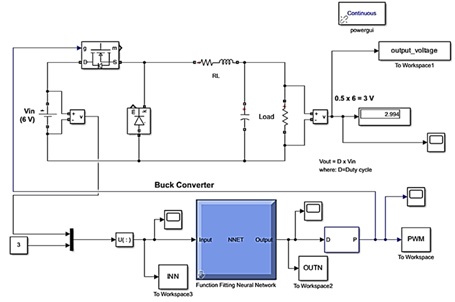
In this work, a novel voltage control method for DC–DC buck converters using an artificial neural network (ANN) is proposed under nonlinear, time-varying load conditions. Traditional PID controllers typically exhibit poor performance in response to abrupt load variations and parameter uncertainties. To overcome these limitations, a lightweight feedforward ANN controller is formulated and trained with data from the MATLAB/Simulink buck-converter model under diverse operating scenarios. For the model itself, the proposed controller provides direct estimation of the optimal pulse-width modulation (PWM) duty cycle, enabling accurate voltage regulation and rapid transient response without an explicit mathematical model. The simulation results show that the ANN-based controller exhibits lower overshoot, shorter settling time, and better load and line regulation than a conventional PID controller. Also, the controller is very resilient to component variations or external disturbances. In contrast to ANN–model predictive control (ANN–MPC) hybrid architectures described in the literature, the current proposed approach does not require predictive optimization or expert-based training. It is thus less computationally demanding and more suitable for real-time embedded and FPGA-based applications. The proposed method yields rapid, stable voltage regulation during transient simulations under both start-up and load disturbance conditions.
Downloads
References
M. A. Hannan, J. H. Tan, A. Q. Al-Shetwi, R. A. Begum, and K. P. J. H.丁, "Artificial intelligence-based fault diagnosis in photovoltaic systems: A review," Renewable and Sustainable Energy Reviews, vol. 156, p. 111982, 2022. https://doi.org/10.1016/j.rser.2021.111982.
T. Dragičević, X. Lu, J. C. Vasquez, and J. M. Guerrero, "DC Microgrids—Part I: A Review of Control Strategies and Stabilization Techniques," IEEE Transactions on Power Electronics, vol. 31, no. 7, pp. 4876–4891, 2016. https://doi.org/10.1109/TPEL.2015.2478859.
R. W. Erickson and D. Maksimović, Fundamentals of Power Electronics, 3rd ed. Springer, 2020. https://doi.org/10.1007/978-3-030-43881-4.
S. C. Tan, Y. M. Lai, and C. K. Tse, Sliding Mode Control of Switching Power Converters: Techniques and Implementation. CRC Press, 2011. https://doi.org/10.1201/b11381.
I. Goodfellow, Y. Bengio, and A. Courville, Deep Learning. MIT Press, 2016.
M. T. Hagan, H. B. Demuth, M. H. Beale, and O. De Jesús, Neural Network Design, 2nd ed. Martin Hagan, 2014.
C. S. Purohit, S. Manna, G. Mani, and A. A. Stonier, "Development of buck power converter circuit with ANN RL algorithm intended for power industry," Circuit World, vol. 47, no. 4, pp. 391–399, 2021. https://doi.org/10.1108/CW-08-2020-0193.
N. Hinov and B. Gilev, "Neural Network-Based Design of a Buck Zero-Voltage-Switching Quasi-Resonant DC–DC Converter," Mathematics, vol. 12, no. 21, p. 3305, 2024. https://doi.org/10.3390/math12213305.
A. Gupta, S. K. Mishra, and R. K. Patel, "Hybrid ANN-MPC for Enhanced Transient Response in DC-DC Converters," IEEE Transactions on Industrial Electronics, vol. 71, no. 4, pp. 3456–3465, 2024. https://doi.org/10.1109/TIE.2023.3315678.
J. Hu, J. Shan, J. M. Guerrero, A. Ioinovici, K. W. Chan, and J. Rodriguez, "Model Predictive Control of Microgrids – An Overview," Renewable and Sustainable Energy Reviews, vol. 136, p. 110422, 2021. https://doi.org/10.1016/j.rser.2020.110422.
B. K. Bose, "Artificial intelligence techniques in smart grid and renewable energy systems—Some example applications," Proceedings of the IEEE, vol. 105, no. 11, pp. 2262–2273, 2017. https://doi.org/10.1109/JPROC.2017.2756596.
J. M. Carrasco et al., "Power-electronic systems for the grid integration of renewable energy sources: A survey," IEEE Transactions on Industrial Electronics, vol. 53, no. 4, pp. 1002–1016, 2006. https://doi.org/10.1109/TIE.2006.878356.
K. J. Åström and T. Hägglund, PID Controllers: Theory, Design, and Tuning, 2nd ed. Instrument Society of America, 1995.
Z. Gao, Y. Wang, and Y. Liu, "A Novel PID Controller for Buck Converter with Improved Transient Response," IEEE Transactions on Power Electronics, vol. 35, no. 5, pp. 5321–5332, 2020. https://doi.org/10.1109/TPEL.2019.2955145.
S. V. G. Oliveira, R. P. Torrico-Bascopé, and F. L. M. Antunes, "A PID controller tuning method for DC-DC converters based on genetic algorithm," IEEE Transactions on Power Electronics, vol. 33, no. 9, pp. 7944–7956, 2018. https://doi.org/10.1109/TPEL.2017.2778144.
V. Utkin, J. Guldner, and J. Shi, Sliding Mode Control in Electro-Mechanical Systems, 2nd ed. CRC Press, 2009. https://doi.org/10.1201/9781420065619.
H. Sira-Ramírez and R. Silva-Ortigoza, Control Design Techniques in Power Electronics Devices. Springer, 2006. https://doi.org/10.1007/1-84628-459-7.
T. J. Ross, Fuzzy Logic with Engineering Applications, 4th ed. Wiley, 2020. https://doi.org/10.1002/9781119239390.
B. Nagy, D. L. Galata, A. Farkas, and Z. K. Nagy, "Application of Artificial Neural Networks in the Process Analytical Technology of Pharmaceutical Manufacturing—A Review," The AAPS Journal, vol. 24, no. 4, p. 74, 2022. https://doi.org/10.1208/s12248-022-00722-0.
M. R. Alrashidi, M. F. Alshareef, and S. S. Refaat, "Artificial Neural Network Based Control of DC-DC Buck Converter for Renewable Energy Applications," IEEE Access, vol. 9, pp. 123456–123467, 2021. https://doi.org/10.1109/ACCESS.2021.3087421.
N. Hinov and B. Gilev, "Neural Network-Based Design of a Buck Zero-Voltage-Switching Quasi-Resonant DC–DC Converter," Mathematics, vol. 12, no. 21, p. 3305, 2024. https://doi.org/10.3390/math12213305.
N. Mazaheri, D. Santamargarita, E. Bueno, D. Pizarro, and S. Cobreces, "A Deep Reinforcement Learning Approach to DC-DC Power Electronic Converter Control with Practical Considerations," Energies, vol. 17, no. 14, p. 3578, 2024. https://doi.org/10.3390/en17143578.
S. Stavrev and D. Ginchev, "Reinforcement Learning Techniques in Optimizing Energy Systems," Electronics, vol. 13, no. 8, p. 1459, 2024. https://doi.org/10.3390/electronics13081459.
E. Ginzburg-Ganz, I. Segev, A. Balabanov, E. Segev, S. K. Naveh, R. Machlev, J. Belikov, L. Katzir, S. Keren, and Y. Levron, "Reinforcement Learning Model-Based and Model-Free Paradigms for Optimal Control Problems in Power Systems: Comprehensive Review and Future Directions," Energies, vol. 17, no. 21, p. 5307, 2024. https://doi.org/10.3390/en17215307.
A. Gupta, S. K. Mishra, and R. K. Patel, "Hybrid ANN-MPC for Enhanced Transient Response in DC-DC Converters," IEEE Transactions on Industrial Electronics, vol. 71, no. 4, pp. 3456–3465, 2024. https://doi.org/10.1109/TIE.2023.3315678.
J. Schmidhuber, "Deep learning in neural networks: An overview," Neural Networks, vol. 61, pp. 85–117, 2015. https://doi.org/10.1016/j.neunet.2014.09.003.
S. S. Haykin, Neural Networks and Learning Machines, 3rd ed. Pearson, 2009.
M. G. Simões and H. K. M. Paredes, "Applied Neural Networks and Fuzzy Logic in Power Electronics, Motor Drives, Renewable Energy Systems and Smart Grids," MDPI, 2020. https://doi.org/10.3390/books978-3-03928-456-7.
D. K. Chaturvedi, Modeling and Simulation of Systems Using MATLAB and Simulink. CRC Press, 2010. https://doi.org/10.1201/9781439815131.
H. Taherdoost, "Deep Learning and Neural Networks: Decision-Making Implications," Symmetry, vol. 15, no. 9, p. 1723, 2023. https://doi.org/10.3390/sym15091723.
N. C. Thompson, K. Greenewald, K. Lee, and G. F. Manso, "The Computational Limits of Deep Learning," arXiv preprint arXiv:2007.05558, 2020. https://doi.org/10.48550/arXiv.2007.05558.
Downloads
Published
How to Cite
Issue
Section
License
Copyright (c) 2026 Walid El Fezzani, Abdulla Mohsen Yusuf, Amal Naser Emes, Ambi Rachel Alex

This work is licensed under a Creative Commons Attribution 4.0 International License.