
Numerical Investigation on the Effect of Using a Heat Sink Integrated with Nano-PCM on the PV Cell Temperature
DOI:
https://doi.org/10.51173/jt.v8i1.2809Keywords:
CFD Simulation, FEM, Cooling PV, PV Cell, Nano-PCM, Fins GeometryAbstract
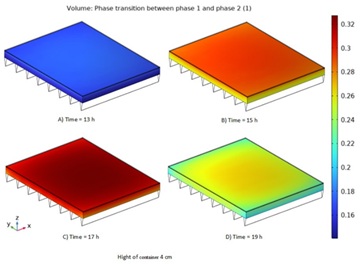
This work is a simulation study of cooling feasibility for a 570 x 670 mm solar cell rated at 50 W, evaluated using COMSOL Multiphysics 6.1. Specifically, the effect of the number of flat fins on the cell temperature is examined. To determine the optimal number of fins, the impact of three fin cross-sections—flat, triangular, and T-shaped—is investigated. Following the selection of the optimum cross-section, the effect of adding a nano-PCM mass to the heat sink is studied. Several masses are analyzed by varying the height of the nano-PCM mass container, with dimensions of 20, 30, and 40 mm. Once the optimum tank height is identified, the feasibility of using water to cool the nano-PCM mass is assessed. The results indicated that eight flat fins can yield a similar temperature despite that the lowest cell temperature has been achieved with 10 flat fins. Therefore, the number of fins is fixed at 8, which reduces the cell temperature to 52.6 °C, a 10% improvement. Subsequently, using triangular-section fins instead of flat ones can reduce the maximum temperature to 50.8 °C, representing an 11.8% improvement. Supporting the heatsink with a 40 mm-thick container filled with nano-PCM can further reduce the cell temperature to 44.67 °C (by 22.5%). Finally, the lowest maximum cell temperature is obtained as 37.9 °C when the nano-PCM described above is cooled with water, resulting in a 34.1% improvement.
Downloads
References
M. Hussein, H. H. Mohammed Ali, and Z. Ali, “Assessing the efficacy of flat-plate solar collectors using nanofluids in the climatic context of Kirkuk city, Iraq”, Acta Polytech, vol. 64, no. 1, pp. 25–33, Mar. 2024, doi: 10.14311/AP.2024.64.0025.
Noor A. Kadhim, Adel A. Obed, Ahmed J. Abid, Ameer L. Saleh, and Reheel J. Hassoon, ‘A Systematic Review for Reconfiguring Photovoltaic Arrays under Conditions of Partial Shading’, Electr. Eng. Tech. J., vol. 1, no. 1 SE-Engineering, pp. 20–34, Jun. 2024, doi: 10.51173/eetj.v1i1.6.
S. A. Hameed, H. H. M. Ali, and S. M. Fakhraldin, “Augmenting the thermal efficiency of solar stills using phase change material on a rotating hollow cylinder,” Int. J. Heat Technol., vol. 43, no. 3, pp. 1187–1194, 2025, doi:10.18280/ijht.430336.
H. Madhi, S. Aljabair, and A. A. Imran, ‘A review of photovoltaic/thermal system cooled using mono and hybrid nanofluids’, Int. J. Thermofluids, vol. 22, p. 100679, 2024, doi: https://doi.org/10.1016/j.ijft.2024.100679.
J. Jiang, Y. Hong, Q. Li, and J. Du, ‘Evaluating the impacts of fin structures and fin counts on photovoltaic panels integrated with phase change material’, Energy, vol. 283, p. 129143, 2023, doi: https://doi.org/10.1016/j.energy.2023.129143.
Khelifa, M. El Hadi Attia, K. Harby, A. Elnaby Kabeel, M. M. Abdel-Aziz, and M. Abdelgaied, ‘Experimental and economic evaluation on the performance improvement of a solar photovoltaic thermal system with skeleton-shaped fins’, Appl. Therm. Eng., vol. 248, p. 123180, 2024, doi: https://doi.org/10.1016/j.applthermaleng.2024.123180.
Y. Hong, D. Bai, Y. Huang, and J. Du, ‘Effect of T-shaped fin arrangements on the temperature control performance of a phase change material heat sink’, Int. Commun. Heat Mass Transf., vol. 148, p. 107073, 2023, doi: https://doi.org/10.1016/j.icheatmasstransfer.2023.107073.
A. Khelifa, M. El Hadi Attia, Z. Driss, and A. Muthu Manokar, ‘Performance enhancement of photovoltaic solar collector using fins and bi-fluid: Thermal efficiency study’, Sol. Energy, vol. 263, p. 111987, 2023, doi: https://doi.org/10.1016/j.solener.2023.111987.
A. Alqatamin, O. A. Al-Khashman, and J. Su, ‘A novel heatsink for optimising photovoltaic cell performance with passive cooling using perforated wave-shaped fins,’ J. Sol. Energy Eng., vol. 147, no. 5, p. 051002, 2025, doi:10.1115/1.4068410.
M. A. Bashir and H. M. Ali, ‘Numerical investigation of passive cooling of the PV module using extended fin heat sinks: A parametric analysis’, Process Saf. Environ. Prot., vol. 195, p. 106749, 2025, doi: https://doi.org/10.1016/j.psep.2025.01.003.
J. Du, D. Bai, X. Meng, F. Jiao, and Y. Hong, ‘Effect of Cantor fractal fin arrangements on the thermal performance of a photovoltaic-phase change material system: An experimental study’, Int. J. Heat Mass Transf., vol. 219, p. 124853, 2024, doi: https://doi.org/10.1016/j.ijheatmasstransfer.2023.124853.
K. S. Unnikrishnan, K. Santhosh, and B. Rohinikumar, “Experimental and numerical analysis of PV-PCM integrated with novel shaped corrugated fins,” Therm. Sci. Eng. Prog., vol. 50, p. 102562, 2024, doi:10.1016/j.tsep.2024.102562.
J. Pu, J. Du, B. Zhang, F. Rong, F. Jiao, and Y. Hong, ‘Thermal management enhancement of photovoltaic panels using phase change material heat sinks with various T-shaped fins’ , Case Stud. Therm. Eng., vol. 61, p. 104991, 2024, doi:10.1016/j.csite.2024.104991.
M. A. Abdel Salam, M. A. Hassab, W. M. El-Maghlany, and M. A. Alnakeeb, “Assessment of fin configuration effect on the performance of photovoltaic thermal systems with trapezoidal tubes and phase change material,” Case Stud. Therm. Eng., vol. 73, p. 106487, 2025, doi:10.1016/j.csite.2025.106487.
S. A. B. Al-Omari, F. Mahmoud, Z. A. Qureshi, and E. Elnajjar, The impact of different fin configurations and design parameters on the performance of a finned PCM heat sink,' Int. J. Thermofluids, vol. 20, p. 100476, 2023, doi:10.1016/j.ijft.2023.100476.
H. Madhi, S. Aljabair, and A. A. Imran, ‘Comparative numerical study on the effect of fin orientation on the photovoltaic/thermal (PV/T) system performance,’ Int. J. Thermofluids, vol. 24, p. 100909, 2024, doi:10.1016/j.ijft.2024.100909.
T. Ambreen and M. H. Kim, ‘Effect of fin shape on the thermal performance of nanofluid-cooled micro pin-fin heat sinks,’ Int. J. Heat Mass Transf., vol. 126, pp. 245–256, 2018, doi:10.1016/j.ijheatmasstransfer.2018.05.164.
F. Bayrak, H. F. Oztop, and F. Selimefendigil, “Effects of different fin parameters on temperature and efficiency for cooling of photovoltaic panels under natural convection,” Sol. Energy, vol. 188, pp. 484–494, 2019, doi:10.1016/j.solener.2019.06.036.
M. S. Ghanim and A. A. Farhan, "Performance evaluation of the photovoltaic thermal system with a fin array and surface zigzag layout," Int. J. Low-Carbon Technol., vol. 17, no. October, pp. 1166–1176, 2022, doi: 10.1093/ijlct/ctac092.
J. Kim and Y. Nam, “Study on the cooling effect of attached fins on PV using CFD simulation,” Energies, vol. 12, no. 4, p. 758, 2019, doi:10.3390/en12040758.
J. Mustafa, S. Alqaed, S. M. Sajadi, and H. Aybar, ‘Enhancing solar panel cooling efficiency: a study on the influence of nanofluid inclusion and pin fin shape during melting and freezing of phase change materials’, Front. Energy Res., vol. 12, no. February, pp. 1–11, 2024, doi: 10.3389/fenrg.2024.1344061.
D. K. Rao, P. Sundaram, K. Selvakumar, D. V. Krishna, A. Sathishkumar, and S. C. Kim, ‘Performance assessment of nano-enhanced organic PCM embedded in heat sinks for PV panel thermal management under outdoor conditions’, Appl. Therm. Eng., vol. 280, p. 128140, 2025, doi: https://doi.org/10.1016/j.applthermaleng.2025.128140.
H. A. Abdul Kareem, A. Khalifa, and A. Hamad, “Investigation of Photovoltaic Membrane Desalination Utilizing Storage Heat in Solar Cells”, International Journal of Thermodynamics, vol. 27, no. 3, pp. 6–14, Sept. 2024, doi: 10.5541/ijot.1390518.
M. Saeed, “Numerical and experimental study enhancement of single-slope solar still productivity using PCM-nanoparticles,” M.S. thesis, Al-Furat Al-Awsat Technical University, Iraq, 2019.
Barrak, Anwar S., Nawfal M. Ali, and Hussein H. M. Ali. "An Effect of Binary Fluid on the Thermal Performance of Pulsation Heat Pipe". International Journal of Applied Mechanics and Engineering 27 no. 1 (2022): 21–34. doi:10.2478/ijame-2022-0002.
H. A. A. Kareem, A. J. Hamad, and A. H. N. Khalifa, “Effect of pore membrane size on the cell temperature and water productivity in photovoltaic membrane distillation,” AIP Conf. Proc., vol. 3350, no. 1, p. 60017, Nov. 2025, doi: 10.1063/5.0297562.
M. K. Rasheed, H. A. Abdul Kareem, F. A. Kareem, and M. A. Al-Obaidi, “Performance enhancement of solar air heater with different roughness absorber plates,” J. Sol. Energy Res., vol. 10, no. 2, pp. 2367–2382, 2025, doi:10.22059/jser.2025.400971.1622.
A. S. Barrak, A. A. M. Saleh, and Z. H. Naji, “A Heat Recovery Device using Oscillating Heat Pipe with Circular and Elliptical Tubes”, Int. J. Automot. Mech. Eng., vol. 18, no. 1, pp. 8442 – 8453, Mar. 2021, doi: 10.15282/ijame.18.1.2021.04.0639.
H. Salah, L. Muthana, and R. Al-Zuhairy, “The influence of ambient conditions on compression ignition engine performance: Experimental study,” J. Mech. Eng. Res. Dev., vol. 43, pp. 317–325, 2020.
Downloads
Published
How to Cite
Issue
Section
License
Copyright (c) 2026 Hussian A. Abdul Kareem, Anwar S. Barrak, Oula M. H. Fatla

This work is licensed under a Creative Commons Attribution 4.0 International License.