
Protocol Efficiency and Resource Utilization in VPN Technologies: A Comparative Analysis of OpenVPN and WireGuard
DOI:
https://doi.org/10.51173/jt.v7i4.2768Keywords:
VPN, OpenVPN, Wire Guard, Performance Evaluation, LatencyAbstract
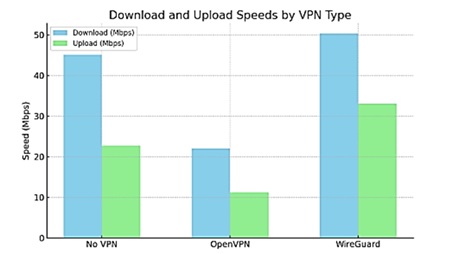
Virtual Private Networks are essential for securing Internet communication, but the selection of a VPN protocol can substantially affect overall network performance. Nonetheless, typical VPN protocols (e.g., OpenVPN) are too secure relative to their worst-case latency and computational overhead. New-generation VPN protocols, such as WireGuard, are said to offer greater efficiency due to a lightweight cryptographic design. This paper then depicts a comparison trial of OpenVPN and WireGuard throughput under controlled cooperation. Download and upload speeds, latency, and CPU and RAM utilization were measured using the Speedtest application on a Windows 11 platform. The results reveal that WireGuard achieved network performance approaching the baseline, with 50.4 Mbps download speeds, low latency (8.01 ms), and low CPU consumption (3%). In contrast, OpenVPN decreased download speeds to 22.1 Mbps and was accompanied by high latency (160.38 ms). The results imply that WireGuard is a valid choice for latency-sensitive and throughput-demanding use cases. In contrast, OpenVPN is appropriate for use cases that focus on interoperability and established security.
Downloads
References
Z. Liu, “Application and Security Analysis of Virtual Private Network (VPN) in Network Communication,” Academic Journal of Computing & Information Science, vol. 6, no. 11, pp. 52–59, 2023, doi: 10.25236/AJCIS.2023.061108.
J. A. Quimpo, Cloud-Based VPN Replacement, Master’s thesis, Theseus (Metropolia UAS), 2024.
V. S. K. Rajak, “Secure remote network: A comprehensive study to secure organization’s remote network and setup secure VPN,” Master’s thesis, National College of Ireland (NCI), Dublin, Ireland, 2024.
A. F. Gentile, D. Macrì, F. De Rango, M. Tropea, and E. Greco, “A VPN Performances Analysis of Constrained Hardware Open Source Infrastructure Deploy in IoT Environment,” Future Internet, vol. 14, no. 9, Art. no. 264, 2022, doi: 10.3390/fi14090264.
A. W. De la Cadena Ramos, Multipath Routing on Anonymous Communication Systems: Enhancing Privacy and Performance, Ph.D. dissertation, University of Luxembourg, Luxembourg, 2021.
N. D. Majeed, A. J. Al-Askery, F. S. Hasan, and S. Abood, “A Survey on Steganography and Image Encryption Techniques”, EETJ, vol. 2, no. 1, pp. 11–24, Jan. 2025.
Hayder Jalo and Mohsen Heydarian, “A Hybrid Technique Based on RF-PCA and ANN for Detecting DDoS Attacks IoT”, IJDS, vol. 1, no. 1, pp. 28–41, Jun. 2024.
B. H. Hameed and Z. A. Saleh, “Progression of the Protection Networking System Depending on International Virtual Private Network,” International Journal of Safety and Security Engineering, vol. 13, no. 5, p. 863, 2023, doi: 10.18280/ijsse.130510.
D. Zela, B. Mema, and K. Zela, “VPN VIRTUAL PRIVATE NETWORK APPLICATIONS IN DATA PREDICTION,” Smart Cities and Regional Development (SCRD) Preprints, vol. 1, no. 1, Dec. 2024.
S. C. Forbacha and J. J. A. Agwu, “Design and Implementation of a Secure Virtual Private Network Over an Open Network (Internet),” American Journal of Technology, vol. 2, no. 1, pp. 1–36, 2023, doi: 10.58425/ajt.v2i1.134.
J. Anyam, R. R. Singh, H. Larijani, and A. Philip, “Empirical performance analysis of WireGuard vs. OpenVPN in cloud and virtualised environments under simulated network conditions,” Computers, vol. 14, no. 8, Art. no. 326, 2025, doi: 10.3390/computers14080326.
P. Jaisudthi, P. T. Sridee, N. Phungkoed, K. Srisuk, and V. Phueaknumpol, “Comparative Study of Modern VPN Solutions: Impact of Cloudflare, ZeroTier, and WireGuard on Network and Server Performance,” Engineering and Technology Horizons, vol. 42, no. 2, Art. no. 420203, Jun. 2025, doi: 10.55003/ETH.420203.
I. Farooq, S. A. Ahmed, A. Ali, M. A. Warraich, M. Aqeel, and H. Khan, “Enhanced classification of networks encrypted traffic: A conceptual analysis of security assessments, implementation trends, and future directions,” The Asian Bulletin of Big Data Management, vol. 4, no. 4, pp. 500–522, Dec. 2024.
S. G. Hussein, “Development of an IPSec VPN on a proposed smart home system,” AIP Conference Proceedings, vol. 3105, no. 1, Art. no. 080001, 2024, doi: 10.1063/5.0212178.
H. Jumakhan and A. Mirzaeinia, “Wireguard: An Efficient Solution for Securing IoT Device Connectivity,” arXiv:2402.02093, 2024, doi: 10.48550/arXiv.2402.02093.
F. Streun, J. Wanner, and A. Perrig, “Evaluating Susceptibility of VPN Implementations to DoS Attacks Using Adversarial Testing,” in Proc. NDSS Symposium, 2022.
E. Dekker and P. Spaans, “Performance comparison of VPN implementations WireGuard, strongSwan, and OpenVPN in a 1 Gbit/s environment,” Univ. of Amsterdam / OS3 project report, 2020.
S. Mackey, I. Mihov, A. Nosenko, F. Vega, and Y. Cheng, “A Performance Comparison of WireGuard and OpenVPN,” in Proc. ACM CODASPY, 2020, pp. 162–164, doi: 10.1145/3374664.3379532.
A. Sivasangari, P. Ajitha, R. M. Gomathi, T. Anandhi, V. D. Vardhini, and P. A. Kumar, “Designing a secure and robust virtual private network (VPN) framework for enhanced network communication protection,” AIP Conference Proceedings, vol. 3257, no. 1, Art. no. 020116, 2025, doi: 10.1063/5.0264873.
H. Abbas et al., “Security Assessment and Evaluation of VPNs: A Comprehensive Survey,” ACM Computing Surveys, vol. 55, no. 13s, pp. 1–47, 2023, doi: 10.1145/3579162.
Downloads
Published
How to Cite
Issue
Section
License
Copyright (c) 2025 Sura Ghanim Hussein, Syed Muhammad Fasih Ur Rehman

This work is licensed under a Creative Commons Attribution 4.0 International License.