
Interactive Modelling Strategy for Predicting the Torsional Dynamic Response of a Damper Pulley
DOI:
https://doi.org/10.51173/jt.v8i1.2906Keywords:
Viscoelastic Damper, Temperature Effect, Experimental-Analytical Coupling, Torsional Vibration, Passive DampingAbstract
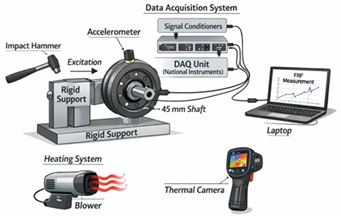
Damper pulleys are critical mechanical subsystems in internal combustion engines that attenuate torsional vibrations arising from cyclic combustion pressures and crankshaft torque fluctuations. Existing modelling approaches range from simple empirical or linear models to advanced numerical formulations; however, few studies systematically incorporate the combined frequency and temperature dependence of elastomer viscoelasticity with a robust experimental identification framework. The strong thermo-mechanical coupling and material nonlinearity therefore still challenge accurate prediction of torsional behaviour under realistic conditions. This study proposes an interactive and novel methodology that couples analytical modelling with experimental identification to characterise the torsional dynamic response of a damper pulley in a thermos-viscoelastic context. Key contributions are: (i) identification of the elastomer complex shear modulus by dynamic mechanical analysis across an extended temperature range; (ii) implementation of these temperature-dependent constitutive parameters in a lumped-parameter torsional vibration model incorporating inertia, stiffness, and viscoelastic damping; and (iii) an iterative calibration procedure correlating analytical predictions with modal parameters extracted from instruments impact tests performed at multiple temperatures. The closed-loop identification updates model parameters systematically until the numerical predictions and experimental measurements converge. Parametric studied quantify the influence of temperature and elastomer thickness: increasing temperature or elastomer thickness reduces the first torsional natural frequency, primarily due to a drop in storage modulus and effective torsional stiffness, whereas decreasing thickness raises the resonance frequency. Predicted and measured natural frequencies differ by less than 5% across the investigated thermal domain, demonstrating the robustness formulation. The developed framework provides a validated and original basis for thermo-viscoelastic modelling, sensitivity analysis, and structural optimisation of torsional vibration dampers under varying operating conditions.
Downloads
References
V. Ganesan, Internal Combustion Engines. New Delhi, India: Tata McGraw-Hill Education, 2003.
Filipović et al., "Preliminary selection of basic parameters of different torsional vibration dampers intended for use in medium-speed diesel engines," Trans. FAMENA, vol. 36, pp. 79-92, 2012.
Tomohito, "Damper pulley manufacturing method and damper pulley manufacturing apparatus," U.S. Patent 20160/102749 A1, 2016.
Y. Honda and T. Saito, "Dynamic characteristics of torsional rubber dampers and their optimum tuning," SAE Tech. Paper 870580, 1987, https://doi.org/10.4271/870580 .
K. Wakabayashi et al., "Torsional vibration damping of diesel engine with rubber damper pulley," JSME Int. J., Ser. C, vol. 38, no. 4, pp. 670-678, Nov. 1995, https://doi.org/10.1299/jsmec1993.38.670.
Z. Zhang et al., "Variable damping mechanism and verification of the torsional damper for a parallel-series hybrid electric vehicle," J. Vibroeng., 2024, https://doi.org/10.21595/jve.2024.24201.
T. Kodama and Y. Honda, "A study on the modeling and simulation method of torsional vibration considering dynamic properties of rubber parts for engine crankshaft system with rubber damper pulley," Int. J. Mech. Eng. Robot. Res., vol. 9, no. 7, Jul. 2020, https://doi.org/10.18178/ijmerr.9.7.1007-1011.
P. Deuszkiewicz and J. Pankiewicz, "Nonlinear model of rubber torsional vibration damper," Vibroeng. PROCEDIA, vol. 6, pp. 78-82, 2015.
V. Píštěk et al., "An unconventional rubber torsional vibration damper with two degrees of freedom," Vibroeng. PROCEDIA, vol. 13, pp. 136-141, 2017, https://doi.org/10.21595/vp.2017.19042.
C. A. F. Silva et al., "Dynamics of torsional vibration damper (TVD) pulley, implementation of rubber elastomeric behaviour, simulations, and experiments," Mech. Ind., vol. 20, no. 2, p. 142, 2019, https://doi.org/10.1016/j.mechmachtheory.2019.103583.
L. Manin, R. Dufour, and S. Schultz, "Pulley torsional vibration damper characterization," Mech. Ind., vol. 14, no. 3, pp. 151-155, 2013, https://doi.org/10.1051/meca/2013057.
Y. A. Yucesan et al., "Adjusting a torsional vibration damper model with physics-informed neural networks," Mech. Syst. Signal Process., vol. 154, Mar. 2021, Art. no. 107602, https://doi.org/10.1016/j.ymssp.2020.107552.
C. R. Stahl, "Development and effects of viscous type dampers on applications other than engine crankshafts," SAE Trans., vol. 97, no. 5, pp. 316-318, 1988, https://doi.org/10.4271/880823.
S. Mendes et al., "Analysis of torsional vibration in internal combustion engines: Modelling and experimental validation," Proc. Inst. Mech. Eng., K, J. Multi-body Dyn., vol. 222, no. 2, pp. 155-165, 2008, doi: 10.1243/14644193JAMD189.
M. H. Sar, O. S. Barrak, A. S. Al-Adili, S. K. Hussein, and A. K. Hussein, “Study the effect of filler material on microstructure of welding the carbon steel in shielded metal arc welding,” Journal of Mechanical Engineering Research and Developments, vol. 43, no. 3, pp. 408–416, 2020.
W. Homik and P. Grzybowski, "The simulation model of small-dimension rubbery torsional vibration damper," Vibroeng. PROCEDIA, vol. 6, pp. 78-82, 2015.
K. Yadav et al., "Critique of torsional vibration damper (TVD) design for powertrain NVH," SAE Tech. Paper 2017-26-0217, 2017, https://doi.org/10.4271/2017-26-0217.
M. Kinoshita, "An experimental study of a torsional/bending damper pulley for an engine crankshaft," SAE Trans., vol. 98, pp. 1605-1615, 1989, https://doi.org/10.4271/891127.
T. Naganuma, H. Okamura, and K. Sogabe, "Experiments and analyses of the three-dimensional vibrations of the crankshaft and torsional damper in a four-cylinder in-line high speed engine," SAE Trans. J. Passenger Cars, vol. 106, no. 6, pp. 3011-3022, 1997, https://doi.org/10.4271/971996.
P. Schwibinger, D. Hendrick, W. Wu, and Y. Imanishi, "Reduction of vibration and noise in the powertrain of passenger cars with elastomer damper," SAE Trans. J. Passenger Cars, vol. 100, no. 6, pp. 787-795, 1991, https://doi.org/10.4271/910616.
L. Drápal and P. Novotný, "Torsional vibration analysis of crank train with low friction losses," J. Vibroeng., vol. 19, no. 8, pp. 6078-6090, Dec. 2017, https://doi.org/10.21595/JVE.2017.17876.
H. Dresig and F. Holzweißig, Dynamics of Machinery - Theory and Applications. Berlin, Germany: Springer, 2010.
M. I. Friswell, J. E. T. Penny, S. D. Garvey, and A. W. Lees, Dynamics of Rotating Machines. Cambridge, U.K.: Cambridge Univ. Press, 2010.
H. Blanc, "Dynamique des rotors en torsion: Étude des amortisseurs de torsion," Tech. l'Ingénieur, Ref. BM5124 V1, 2000.
J. D. Ferry, Viscoelastic Properties of Polymers, 3rd ed. New York, NY, USA: John Wiley & Sons, 1980.
Downloads
Published
How to Cite
Issue
Section
License
Copyright (c) 2026 Walid Baccar, Ezzeddine Ftoutou, SeddiK Shiri, Moez Trigui

This work is licensed under a Creative Commons Attribution 4.0 International License.