
Monitoring Indoor Air Quality Using Low-Cost IoT
DOI:
https://doi.org/10.51173/jt.v7i2.1987Keywords:
Air Quality, Arduino, IoT, Online Monitoring, ThinkSpeakAbstract
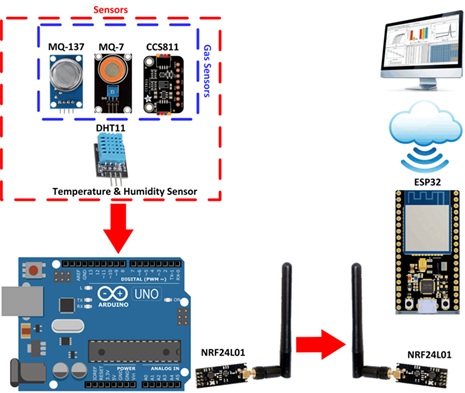
Measuring air quality in some regions under non-ideal circumstances is still a challenge. In many third-world countries, acquiring expensive air quality testing equipment is beyond capacity. Monitoring non-healthy environments in such regions is vital, so we implemented a low-cost IoT indoor air quality tester. The system comprises attached field instrument sensors and a WiFi-to-cloud monitoring unit. The sensing unit includes Arduino UNO attached to MQ-7, CCS811, and MQ-137 sensors to measure carbon monoxide (CO), carbon dioxide (CO2), and the total volatile organic compounds (TVOCs), and NH3, respectively. The sensors also include the DHT11 to measure temperature (T) and relative humidity (RH). To collect data from distributed field sensing devices and monitor it on the ThingSpeak website, an NRF24l01+ wireless model is connected to each data logger and the central data collector ESP32. The proposed low-cost system was operated in one of the higher education buildings of the Middle Technical University, measuring the concentrations of the most common air quality factors (CO, CO2, NH3, TVOC, RH, and T).
Downloads
References
O. US EPA, “Managing air quality - air pollutant types,” Dec. 10, 2015. https://www.epa.gov/air-quality-management-process/managing-air-quality-air-pollutant-types (accessed Apr. 01, 2023).
S. Abraham and X. Li, “A cost-effective wireless sensor network system for indoor air quality monitoring applications,” Procedia Computer Science, vol. 34, pp. 165–171, Jan. 2014, doi: 10.1016/j.procs.2014.07.090.
S. Bhattacharya, S. Sridevi, and R. Pitchiah, “Indoor air quality monitoring using wireless sensor network,” in Proceedings of the 2012 Sixth International Conference on Sensing Technology, Kolkata, India: IEEE, Dec. 2012, pp. 422–427. doi: 10.1109/ICSensT.2012.6461713.
P. Asha et al., “IoT enabled environmental toxicology for air pollution monitoring using AI techniques,” Environmental Research, vol. 205, p. 112574, 2022, doi: 10.1016/j.envres.2021.112574.
S. Ochie, M. R. Usikalu, A. Akinpelu, W. A. Ayara, and O. W. Ayanbisi, “Design and construction of a home air quality monitoring system,” IOP Conf. Ser.: Earth Environ. Sci., vol. 993, no. 1, p. 012022, 2022, doi: 10.1088/1755-1315/993/1/012022.
J. Jo, B. Jo, J. Kim, S. Kim, and W. Han, “Development of an IoT-based indoor air quality monitoring platform,” Journal of Sensors, vol. 2020, p. e8749764, 2020, doi: 10.1155/2020/8749764.
A. Rackes, T. Ben-David, and M. S. Waring, “Sensor networks for routine indoor air quality monitoring in buildings: Impacts of placement, accuracy, and number of sensors,” Science and Technology for the Built Environment, vol. 24, no. 2, pp. 188–197, Feb. 2018, doi: 10.1080/23744731.2017.1406274.
M. Alvarez-Campana, G. López, E. Vázquez, V. A. Villagrá, and J. Berrocal, “Smart CEI Moncloa: an IoT-based platform for people flow and environmental monitoring on a smart university campus,” Sensors, vol. 17, no. 12, Art. no. 12, Dec. 2017, doi: 10.3390/s17122856.
H. Cho, “An Air Quality and Event Detection System with Life Logging for Monitoring Household Environments,” in Smart Sensors at the IoT Frontier, H. Yasuura, C.-M. Kyung, Y. Liu, and Y.-L. Lin, Eds., Cham: Springer International Publishing, 2017, pp. 251–270. doi: 10.1007/978-3-319-55345-0_10.
M. S. Wong, T. P. Yip, and E. Mok, “Development of a personal integrated environmental monitoring system,” Sensors, vol. 14, no. 11, Art. no. 11, Nov. 2014, doi: 10.3390/s141122065.
F. Salamone, L. Danza, I. Meroni, and M. C. Pollastro, “A low-cost environmental monitoring system: how to prevent systematic errors in the design phase through the combined use of additive manufacturing and thermographic techniques,” Sensors, vol. 17, no. 4, Art. no. 4, 2017, doi: 10.3390/s17040828.
G. Marques, C. R. Ferreira, and R. Pitarma, “Indoor air quality assessment using a CO2 monitoring system based on internet of things,” J Med Syst, vol. 43, no. 3, p. 67, Feb. 2019, doi: 10.1007/s10916-019-1184-x.
G. Marques and R. Pitarma, “Monitoring health factors in indoor living environments using internet of things,” in Proccedings of the World Conference on Information Systems and Technologies, Á. Rocha, A. M. Correia, H. Adeli, L. P. Reis, and S. Costanzo, Eds., in Advances in Intelligent Systems and Computing. Madeira, Portugal: Springer International Publishing, 2017, pp. 785–794. doi: 10.1007/978-3-319-56538-5_79.
G. Marques, C. Roque Ferreira, and R. Pitarma, “A system based on the internet of things for real-time particle monitoring in buildings,” International Journal of Environmental Research and Public Health, vol. 15, no. 4, Art. no. 4, 2018, doi: 10.3390/ijerph15040821.
M. Taştan and H. Gökozan, “Real-time monitoring of indoor air quality with internet of things-based e-nose,” Applied Sciences, vol. 9, no. 16, Art. no. 16, 2019, doi: 10.3390/app9163435.
D. Wall, P. McCullagh, I. Cleland, and R. Bond, “Development of an internet of things solution to monitor and analyse indoor air quality,” Internet of Things, vol. 14, p. 100392, 2021, doi: 10.1016/j.iot.2021.100392.
Nao Nakamura, “Toyochem develops low-odor, low-VOC acrylic adhesive for vehicle & building interiors; T-VOC 10% of conventional products”, Green Car Congress, 25 March 2022. https://www.greencarcongress.com/2022/03/20220325-toyochem.html.
M. Oliveira, K. Slezakova, C. Delerue-Matos, M. do C. Pereira, and S. Morais, “Indoor air quality in preschools (3- to 5-year-old children) in the Northeast of Portugal during spring–summer season: pollutants and comfort parameters,” Journal of Toxicology and Environmental Health, Part A, vol. 80, no. 13–15, pp. 740–755, Aug. 2017, doi: 10.1080/15287394.2017.1286932.
IAMAT. (n.d.). Iraq: Air pollution. IAMAT. Retrieved April 7, 2022, from https://www.iamat.org/country/iraq/risk/air-pollution.
T.W.A.Q.I. Project. (n.d.). Air pollution in Iraq: Real-time air quality index visual map. AQICN. Retrieved April 7, 2022, from https://aqicn.org/map/iraq/.
Automeris. (n.d.). WebPlotDigitizer: Extract data from plots, images, and maps. Retrieved November 28, 2022, from https://automeris.io/WebPlotDigitizer/.
D-Robotics. (2010). DHT11 humidity & temperature sensor [Data sheet]. Retrieved from https://www.digikey.at/htmldatasheets/production/2071184/0/0/1/dht11-humidity-temp-sensor.html.
Ams AG. (2018). CCS811 ultra-low power digital gas sensor for monitoring indoor air quality [Data sheet]. Retrieved November 26, 2022, from https://cdn.sparkfun.com/assets/2/4/2/9/6/CCS811_Datasheet.pdf.
Ams AG. (2018). CCS811 application note: End of line functionality testing [Application note]. Retrieved November 26, 2022, from https://www.sciosense.com/wp-content/uploads/documents/CCS811-Application-Note-End-of-Line-Functionality-Testing.pdf.
Ams AG. (2018). Application note: Baseline save and restore on CCS811 [Application note]. Retrieved November 26, 2022, from https://www.sciosense.com/wp-content/uploads/documents/Application-Note-Baseline-Save-and-Restore-on-CCS811.pdf.
ThingSpeak. (n.d.). IoT analytics: ThingSpeak Internet of Things. Retrieved September 7, 2023, from https://thingspeak.com/.
Downloads
Published
How to Cite
Issue
Section
License
Copyright (c) 2025 Mohanad H. Mahmood, Kamal Y. Kamal, Saif S. Hussein

This work is licensed under a Creative Commons Attribution 4.0 International License.